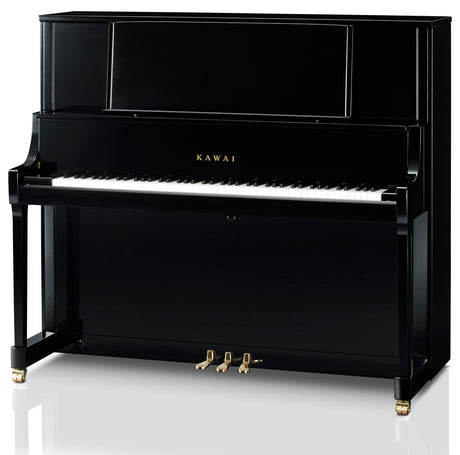
With the Master Series, Kawai places a new class of upright pianos above the well-established K Series. A Kawai Master Series piano brings construction features usually reserved for grand pianos into the upright format.
In this spotlight we place the two models we carry, the MS-123 and MS-130: character, action, materials, and the question of who the step up from the K Series into the Master Series truly suits.
01What defines the Master Series
The Master Series is Kawai s premium line among upright pianos. The aim: to bring as much grand-piano character as possible into an upright. Three pillars carry it.
First, the hand-wound bass strings, which according to Kawai match those of Shigeru Kawai grand pianos. Second, a solid spruce soundboard with reinforced frame and back-post construction, engineered for long, sustained resonance. Third, the Millennium III action with ABS-Carbon components, offering more precision, stability and repetition speed than wood alone.
Grand-piano details round it off: a lift-up topboard and bird s-eye maple sideboards that visually echo a Shigeru Kawai grand. A standout is the combination of a muffler mechanism and a sostenuto pedal in an upright, a pairing rarely found together on this format.
02MS-123 and MS-130 compared
Both models share the action, soundboard material and Master Series appointments. The main difference lies in height, and therefore in tonal volume.
The MS-123 stands 123 cm tall and is the more compact instrument of the line, ideal where floor space and room volume are limited, without giving up Master Series substance. The MS-130 stands 130 cm; the greater height means longer strings and more soundboard area, translating into fuller bass and more tonal reserve in forte. Both feature the sostenuto pedal with muffler.
Those with the room and a wish for the full sound body will reach for the MS-130; where things must stay compact, the MS-123 remains the undiluted Master Series experience.


| Feature | MS-123 | MS-130 |
|---|---|---|
| Height | 123 cm | 130 cm |
| Action | Millennium III (ABS-Carbon) | Millennium III (ABS-Carbon) |
| Soundboard | solid spruce | solid spruce |
| Bass strings | hand-wound | hand-wound |
| Pedals | 3, with sostenuto + muffler | 3, with sostenuto + muffler |
| Tonal character | compact, precise | fuller bass, more reserve |
03Master Series or K Series
The K Series is Kawai s proven mid-to-upper class and our best-selling acoustic piano segment. It shares the Millennium III action and the solid soundboard with the Master Series and offers a very coherent value across the range.
The Master Series sits above it: the grand-leaning string and soundboard design, the bird s-eye maple look and the sostenuto-muffler combination make it the choice for players seeking the maximum tonal volume and grand-piano feel in an upright instrument. Those wanting a high-quality, durable piano at a clear price are well served by the K Series; those wanting the premium peak will find it in the Master Series.
For a direct comparison at the top of the K Series, the Kawai K-800 AS Klavier is on hand.

The Master Series is Kawai s attempt to bring grand-piano substance into the upright format, and it succeeds convincingly. The MS-123 and MS-130 are not simply larger K Series models but a premium class of their own. For more on Kawai s hybrid world, see our spotlights on the Novus range and on hybrid pianos in general.
Frequently asked questions
What is the difference between the Kawai Master Series and the K Series?
Which Master Series models does Musik Ebert carry?
Is the larger MS-130 worth it over the MS-123?
What does the sostenuto-muffler combination mean?
Explore the Kawai Master Series
The MS-123 and MS-130 along with the full selection of new pianos at a glance.
View new pianosExplore the Kawai MS-130Passende Produkte