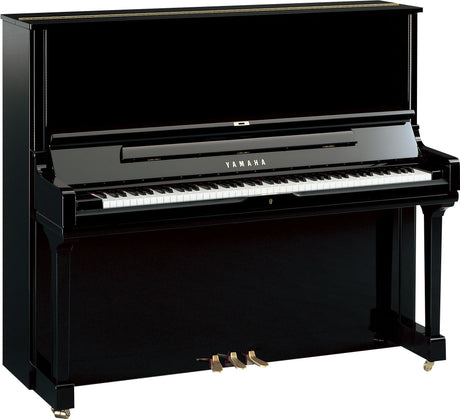
Wanting to practise piano quietly in a rented flat is one of the most common reasons players come to us. The worry is always the same: thin walls, sensitive neighbours, and the wish to play late in the evening without disturbing anyone.
The good news is that there are three very different solutions, and all of them work. They differ noticeably in feel, sound and price, though. This article sorts out the three routes and gives a clear recommendation depending on your home and budget.

A real piano with a mute switch
Ideal for: For anyone who wants an acoustic piano and only needs to switch to headphones at night
See all Klaviere - Neu →Always quiet, always adjustable
Ideal for: For anyone saving space and budget who mostly plays with headphones
See all Klaviere - Neu →01The core problem: a piano is loud, a flat carries sound
An acoustic piano makes its sound by hammers striking tensioned strings, with the soundboard amplifying that tone. That is exactly what creates the warm, living sound, and exactly what travels through walls and ceilings.
So if you want to practise quietly in a flat, you either need to make the acoustic tone switchable, or choose an instrument whose volume can be controlled from the start. That gives the three routes: the silent piano, which combines real piano action with a mute function, the hybrid piano without strings, and the pure digital piano.
02Route 1: the silent piano, a real piano with a headphone mode
A silent piano is a full acoustic piano with strings and soundboard. It also has a stop rail built in: when you switch to silent mode, this rail catches the hammers just before the strings, so no acoustic tone is produced. Optical sensors read the touch of each key and generate a digital sound through a tone generator, which you hear over headphones.
The key point: during the day you play a completely normal acoustic piano with its full, real sound. In the evening or at night you mute it and practise on headphones without disturbing the neighbours. So you get the real piano and the quiet option in one instrument. Examples from our range are the Yamaha B30 Klavier schwarz poliert mit SC3 Silent System as a compact entry point and the Yamaha YUS-3 Klavier schwarz poliert mit SH3 Silent System in the upper class.


03A variant of it: TransAcoustic instead of headphones only
Closely related to the silent piano is the TransAcoustic approach. Here the digital sound does not come from external speakers; instead a built-in transducer makes the piano soundboard itself vibrate. The tone radiates from the body of the piano, while the volume stays steplessly adjustable, without headphones.
For a flat this means you can play very softly without a cable on your head, and still keep the natural resonant character. The strings remain in place, so the instrument is still a fully playable acoustic piano.
04Route 2: the hybrid piano, real action without strings
A hybrid piano is the middle route. It has a real upright or grand action with wooden hammers, so the same feel as an acoustic piano, but no strings and no soundboard. The sound is generated entirely digitally and is therefore adjustable at any time, or audible on headphones.
Because no strings are tensioned, a hybrid never needs tuning and stays stable for good. It is noticeably quieter in background noise than a silent piano, while keeping the demanding action. An important distinction: unlike a silent piano, a hybrid has no strings, so it is not an acoustic instrument with a mute, but a digitally voiced instrument with a real action. Makers such as Yamaha and Kawai lean towards sampling, while Casio and Roland lean towards sound modelling, which leads to different tonal characters.
05Route 3: the digital piano, the space-saving, affordable solution
The pure digital piano has neither strings nor a classic piano action, but a weighted hammer keyboard that mimics the feel. The sound is always digital, always adjustable, and completely silent to the outside on headphones. It is the lightest, most compact and by far the most affordable of the three.
For many flat situations this is the pragmatic choice: anyone who mostly practises with headphones anyway, rarely has an audience, and values low weight and a small footprint is very well served by a good digital piano. The difference from the silent piano lies in the acoustic experience, because a digital piano always sounds through speakers, never through real strings.
| Silent piano | Hybrid piano | Digital piano | |
|---|---|---|---|
| Strings present | yes | no | no |
| Real action | yes, full | yes, wooden hammers | weighted keyboard |
| Quiet practice | headphone mode | adjustable / headphones | adjustable / headphones |
| Needs tuning | yes | no | no |
| Footprint / weight | high | medium to high | low |
| Price level | from upper | upper | from affordable |
06Placement and structure-borne noise in brief
Even the quietest playing on headphones still transmits something: the structure-borne noise of the action and the soft tapping of the keys. With a silent piano or a hybrid with a real action this can travel through the floor to the flat below. Decoupling pads or a piano rug underlay dampen this structure-borne noise.
As a rule, do not place the instrument against the thinnest party wall to the neighbour, but against a load-bearing inner or outer wall. For a selection of instruments, take a look at our category Klaviere - Neu.
There is no single right answer, but three good routes that suit different living situations. Anyone who does not want to give up the real piano sound and only needs to practise quietly in the evening is best served by a silent piano. Anyone seeking maximum quiet and tuning freedom with a real action should look at a hybrid. Anyone saving space and budget takes a good digital piano. The key is to honestly assess how often you really want to play acoustically and how much space your flat allows.
Frequently asked questions
Can I really play at night on a silent piano without disturbing the neighbours
What is the difference between a silent piano and a hybrid piano
Does a silent piano still need tuning
Which solution is best for a small flat
How loud is the key noise in silent mode
Find the right instrument for your home
Browse our selection of new pianos, including models with a silent system for quiet practice.
View new pianosYamaha B30 with silent systemPassende Produkte