Anyone who wants to practise in the evening without disturbing the family or the neighbours sooner or later comes across the term silent piano. The question behind it is always the same. How does a piano go silent while remaining a real acoustic instrument with strings? The answer lies in two unassuming parts that work together.
In this guide we show what happens inside when you press the middle pedal, why the touch does not change, and how the main manufacturers implement the technology. If you are looking for the difference between a silent system and a true stringless hybrid piano, you will find the pointer further down.
01The basic principle: keys play, strings stay quiet
A silent piano is first of all a perfectly normal acoustic piano with a wooden action, hammer heads and tensioned strings. It can be played fully acoustically at any time, just like any other instrument. The trick lies in a second operating mode that you switch on with a lever or the middle pedal.
When silent mode is engaged, two things happen at once: the hammers are prevented from hitting the strings, and a digital sound system takes over tone generation. What the player hears then comes through headphones, while the room stays quiet. The piano loses none of its acoustic ability, it simply gains a second voice.
02The hammer stop bar: how the strings fall silent
The central component is the hammer stop bar, also called a stop rail, mute rail or stop bar depending on the maker. It sits across the action, just before the strings. In normal play it is folded away and does not interfere.
When you switch to silent, the bar swings into the path of the hammer shanks. The hammers still move forward as usual when a key is struck, but they are caught by the bar just before they would touch the string. No acoustic tone is produced. The key point is that the action itself is not altered. The hammer travels almost the same distance as in acoustic play and is only stopped in the last few millimetres. That is exactly why the touch feels practically unchanged in silent mode.
03Optical sensors: reading the key strike
When the strings stay quiet, another source has to deliver the sound. For this, contactless optical sensors sit under the keys and at the hammers. They measure which key is struck, how fast and how deep, and pass this information to a digital tone generator that plays back a high-quality sample of a concert grand.
The important word is contactless: the sensors read the key strike using light, without intervening mechanically in the movement. They slow nothing down and add no extra weight. That is why the dynamics are preserved: a soft pianissimo sounds soft, a powerful forte sounds loud. Yamaha uses an optical system at the keys and hammers, while Kawai measures hammer movement with a high-resolution optical sensor system. The result is the same in both cases: a digital sound that closely follows the real key strike.
04Why the touch stays the same
Many people worry that a silent piano feels like a keyboard with a plastic action. With a genuine silent system that is not the case, and the reason lies in the construction. The keyboard, the wooden action and the hammer heads are the same ones the piano uses to play acoustically. In silent mode only the end of the hammer movement changes.
Because neither the stop bar permanently alters the action nor the sensors physically intervene, the key resistance, the let-off feel and the repetition all remain intact. You practise on exactly the instrument you will later play acoustically. That is the difference from a pure digital piano and the main reason many piano students prefer a silent piano to owning a second device.


05Brands compared: same principle, different names
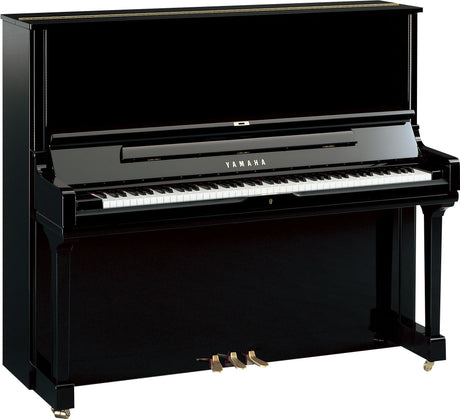
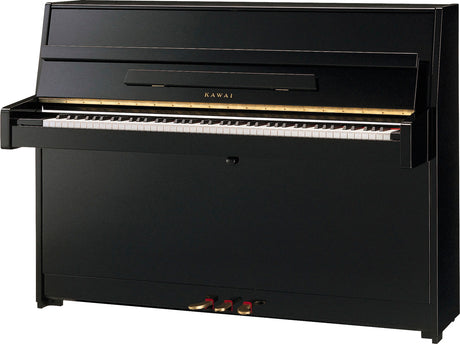
The idea is the same across brands, only the names differ. Yamaha calls its system SH3 or SC3 depending on the model, Kawai markets the AnyTime range as ATX3L and ATX4, and Schimmel offers a comparable solution called Twin Tone. All of them stop the hammers before the strings and read the key strike with optical sensors.
The technology is not limited to upright pianos. Grand pianos can be fitted with a silent system too, for example a Kawai GL-10 with ATX4. If you are looking for a piano with a silent practice option, you will find models here from the compact entry level to the higher class. A fundamentally different family is the true stringless hybrid piano, which no longer has an acoustic mode. We explain that difference in our article on hybrid pianos.


| Manufacturer | System name | Hammers stopped | Sensor type |
|---|---|---|---|
| Yamaha | SH3 / SC3 | yes, stop bar before the strings | optical, contactless |
| Kawai | ATX3L / ATX4 | yes, stop rail before the strings | optical, contactless |
| Schimmel | Twin Tone | yes, stop bar before the strings | optical, contactless |
A silent piano solves a very practical conflict: by day the full acoustic instrument, in the evening the silent practice option through headphones. This is made possible by a simple, robust interplay of a hammer stop bar and contactless optical sensors that leaves the action untouched. If you are weighing up whether a silent piano or a stringless hybrid piano suits you better, it helps to look at both concepts side by side.
Frequently asked questions
Does a silent piano still have real strings?
Does silent mode change the touch?
How do I hear the sound when the strings stay quiet?
What is the difference between silent and a stringless hybrid piano?
Can grand pianos also be made silent?
Discover pianos with a silent system
From the compact entry-level upright to the higher class, with a silent practice option for any time of day.
Browse new pianosYamaha B30 with SilentPassende Produkte


Kawai K-200 upright piano polished black – 114 cm height, ATX4 Silent system, Millennium III action