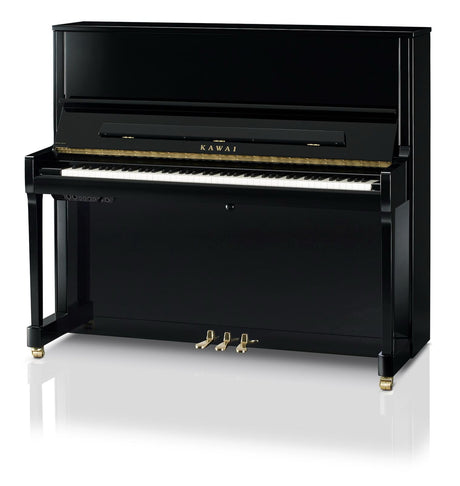
The question of TransAcoustic or AURES 2 comes up when an acoustic piano should do more than just sound acoustic: play quietly, practise with headphones, blend in your own recordings. Both systems solve this the same way, and yet differently.
What makes them special: neither Yamaha nor Kawai builds in external speakers. Instead of a speaker box, a transducer drives the piano soundboard, so the digital sound comes from the body of the instrument itself. The piano remains a full acoustic piano with real strings.

A custom transducer in the soundboard
Ideal for: For players who want the familiar Yamaha sound and a discreet system built into the action.
See all Klaviere - Neu →Four Onkyo transducers for a fuller sound
Ideal for: For players who prefer a rich, room-filling digital sound from the soundboard.
See all Klaviere - Neu →01The Shared Principle: Soundboard Instead of Speakers
Both systems sit in an ordinary acoustic piano with strings and a soundboard. The difference from a plain silent system: when you play with headphones, in both cases the hammers are stopped just before the strings and optical sensors read your touch. So far, TransAcoustic and AURES 2 behave like a silent piano.
The real trick happens without headphones. A transducer, an electromechanical converter, transmits the digital sound as fine vibrations directly to the wooden soundboard. The soundboard vibrates and releases the tone into the room, just as in acoustic play. There is no visible speaker box, the sound comes from the piano itself, and the volume can be adjusted continuously.


02Yamaha TransAcoustic in Detail
Yamaha fits its TransAcoustic models with a transducer developed specifically for pianos. Conventional converters would be too heavy and would interfere with the acoustic function of the soundboard. Yamaha solution is light enough to let the board vibrate freely while transmitting the digital sound cleanly.
The current generation carries the designation TA3 on larger uprights and grand pianos, and TC3 on the more compact models. Tonally you stay in the familiar Yamaha world, the sampling comes from the company concert grands. Anyone who already values the Yamaha character will find a discreetly integrated system here that does not change the feel of the acoustic piano.


03Kawai AURES 2 in Detail
With the AURES 2, Kawai takes a similar but broader approach. Instead of a single converter, four transducers developed together with Onkyo sit directly on the solid spruce soundboard. Two cover the low and mid range, two the high range. The goal is a particularly full, room-filling sound.
Because the entire digital tone is created through the soundboard, the AURES 2 does not sound like a speaker inside the piano, but carries the natural tonal character of the wood. AURES 2 is the second generation of the system and, compared to the first AURES, relies on additional transducers for greater tonal depth. It is available, among others, on the popular K-Series uprights from Kawai.

04The Differences at a Glance
In their basic idea, TransAcoustic and AURES 2 are very similar: an acoustic piano whose soundboard carries the digital sound. The differences lie in the detail of the implementation, the brand world and the tonal character.
| Feature | Yamaha TransAcoustic | Kawai AURES 2 |
|---|---|---|
| Transducer | One custom converter | Four Onkyo transducers |
| Sound generation | Sampling from Yamaha concert grands | Kawai sound engine |
| Designation | TA3 / TC3 | AURES 2 (second generation) |
| Strings and action | Fully playable acoustically | Fully playable acoustically |
| Tonal character | Discreet, familiar Yamaha | Full, room-filling |
05Who Each System Suits
Both systems are aimed at players who want a real acoustic piano but also want to stay flexible: practise quietly without disturbing the neighbours, play with headphones in the evening or record their own playing. Anyone looking for a plain silent piano without soundboard playback is better served by the silent version. Anyone who does not need strings and wants a fully digital hybrid instrument should look at our articles on hybrid pianos.
Brand preference often makes the difference: those used to the Yamaha sound stay in their world with TransAcoustic. Those looking for the warm, broad Kawai character with a particularly full soundboard tone will find the right system in the AURES 2. In both cases, a look at the Klaviere - Neu helps to match model, cabinet height and features.
TransAcoustic or AURES 2 is ultimately less a question of technology than of tonal character and brand preference. Both bring the digital sound elegantly out of the soundboard, both leave the acoustic piano untouched. To compare both worlds, you will find the matching models directly in the range.
Frequently asked questions
What is the difference between TransAcoustic and a silent piano?
Do TransAcoustic and AURES 2 have speakers?
Does the piano stay a full acoustic instrument?
How do the two transducer systems differ tonally?
On which models are the systems available?
Discover Pianos with a Transducer System
Compare TransAcoustic and AURES 2 on concrete models and find the piano that fits your sound and your room.
View all new pianosKawai K-300 AURES 2Passende Produkte
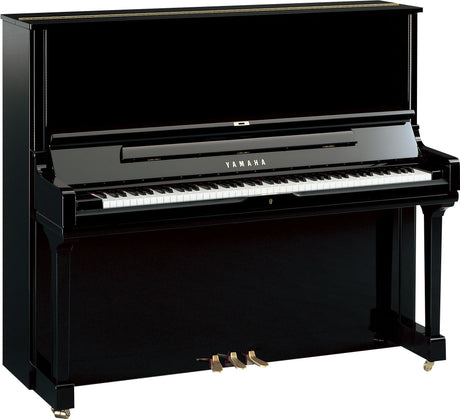

Yamaha YUS-3 Upright Piano in Polished Ebony with TA3 Transacoustic System



Yamaha YUS-5 Upright Piano in Polished Ebony with TA3 Transacoustic System